The Antarctic Journals of Reginald Skelton
A century after the Discovery Expedition froze fast in McMurdo Sound, his granddaughter opened the journals he left behind, and brought his voice back from the ice.

An absolutely essential addition to any Polar enthusiast's library.
Four years, one ship,
frozen fast at the bottom of the world.
Reginald Skelton sailed as Chief Engineer under Captain Scott. As the expedition's official photographer, he was also the one behind the camera for much of what the world came to see of Discovery. Scroll, and follow the ship south.
Departure
Discovery is built in Dundee, provisioned, and celebrated before setting sail for the unknown south, carrying a young engineer who would also end up in charge of the ship's photography.
Five months at sea
The ship calls at Madeira, South Trinidad, South Africa, Macquarie Island, and New Zealand for coal, supplies, repairs, and science, and is met everywhere with generosity and hospitality.
Into the ice
Discovery steams south in search of a safe winter haven, sights land beyond the Great Ice Barrier farther east than any expedition before her, and makes the first flight in Antarctica, by hydrogen balloon.
Frozen fast, two winters running
Discovery is held in the ice far longer than planned. Reginald keeps the engines alive, keeps the photographs coming, and keeps mending whatever breaks, earning the nickname that gives this book its title.
Return
The expedition comes home to a hero's welcome. Reginald's seven volumes of journals, his sledging diaries, and his photographs go quiet for almost a century.
Reopened
His granddaughter Judy sits down in the library at the Scott Polar Research Institute and begins to read the journals of a grandfather she remembered only as a gravelly voiced old man who chuckled a lot.
The ice kept his story
exactly as he lived it.
Six moments from Reginald's seven volumes, written as they happened, by a young man who had no idea what would come next.
The first flight over Antarctica
Discovery's crew makes the first Antarctic flight, rising above the ice in a hydrogen balloon.
The troublesome windmill
Meant to light the ship through the months of darkness, it kept the engineers busy all autumn, until a winter gale blew it to smithereens, to their great relief.
Lost within sight of the ship
Reginald and the physicist Bernacchi nearly perish in a blizzard, a quarter of a mile from Discovery.
A world first
With Evans and Quartley, Reginald discovers the first Emperor penguin colony ever seen by humans, and takes the first photographs of Emperor chicks.
The South Polar Times
Spirits rise with the first issue of the expedition's own newspaper, illustrated with sketches by Dr Edward Wilson.
Toward the Polar Plateau
Reginald joins Armitage's twelve-man party to climb the Blue Glacier toward the Western Mountains, the journey that led to the discovery of the Polar Plateau.
The grandfather who wrote it.
The granddaughter who found it.
Reginald's expedition and Judy's years in the archives run side by side through this book, a century apart, and closer than they look.
The archivist apologized for the terrible noise of the construction work outside, but all I could hear was the sound of the Discovery's bows scrunching through the pack ice, and the howl of the Antarctic wind.
Judy Skelton, on first opening the journalsReginald, 1901–1904
Judy, a century later
Chief Engineer, still in his twenties
Reginald sails south with Scott, keeping Discovery's engines running and serving as the expedition's official photographer.
An accidental beginning
Judy was only ten when he died in 1956, and he never told her about Antarctica. Decades later, a travel book sends her looking for his papers.
Two winters in the ice
The ship is frozen in far longer than planned. Reginald keeps a private journal alongside his official duties.
Into the archive
Judy reads the seven volumes and his sledging diaries more times than she can count, and finds something new every time.
Motorized sledges
Back in England, Reginald works with Scott developing early motorized sledges for a return south.
The words as he wrote them
She discovers that some books had misquoted his journals, and resolves to publish the full, authentic text.
Seven volumes, waiting
Reginald's full journals stay largely unread outside the family for the better part of a century.
The full journals, published
Judy brings Reginald's complete journals into print, so anyone can share the pleasure of sailing with Discovery.
The man who photographed Antarctica.
The woman who followed him south.
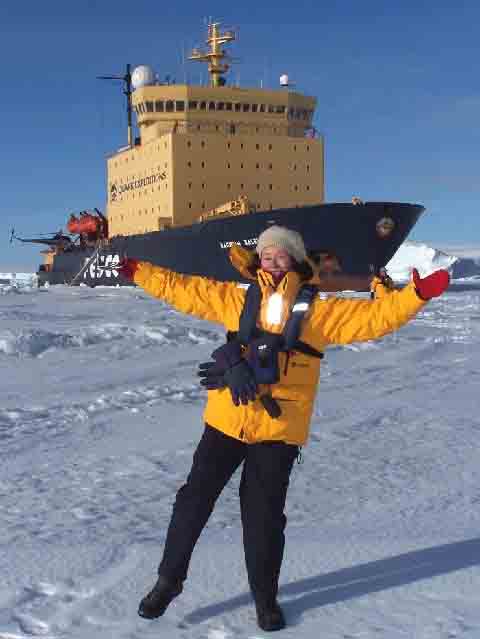
Reginald was Discovery's official photographer. A century later, Judy went to see the ice herself, and took her own turn dog-sledging in Arctic Norway for the Friends of SPRI.



The journals, the photographs,
the ice itself.
A short visual journey through Reginald's journals and photographs, set to music, the pages and images that became this book.
Judy Skelton
Judy Skelton was only ten when her grandfather died, and he never told her about his time in the Antarctic. Decades later, she went looking for what he had actually written down.
She read Physics at St Anne's College, Oxford, then taught for two years in India through VSO, the start of a long career in international development with organizations including VSO, CARE, WaterAid, and Population Concern, which took her to live in India, Mexico, and Tanzania.
A travel book about Antarctica sent her looking for Reginald Skelton's bequeathed papers at the Scott Polar Research Institute in Cambridge. She co-created "Discovery Illustrated" for the expedition's centenary, and eventually brought his full journals to publication under this title.
She has since visited the Ross Sea and McMurdo Sound herself, serves as Treasurer of the Friends of SPRI, and in 2006 took part in their first Great Dog-Sledging Challenge in Arctic Norway. In 2007, she and her grandfather were the subject of a BBC Radio 4 program on inheritance.
Another little job for the Tinker.
One journal. Two winters in the ice. A century of silence, thawed.
An almost exact facsimile of the original seven volumes, with 182 photographs, many taken by Reginald himself, plus extracts from The South Polar Times and sketches by Dr Edward Wilson.
Direct from the publisher
Order straight from Reardon Publishing at the Antarctic Bookshop, or email orders@reardon.biz with your postal address.
Visit the Antarctic BookshopAbeBooks
New and collectible copies from independent booksellers.
Find it on AbeBooksFrom Scott's first expedition
to his last.

Terra Nova Illustrated: Vanguard Edition
The first complete Who's Who of everyone who sailed with Captain Scott's Terra Nova expedition, 1910 to 1913. A limited-run field guide to the men of Scott's last expedition.